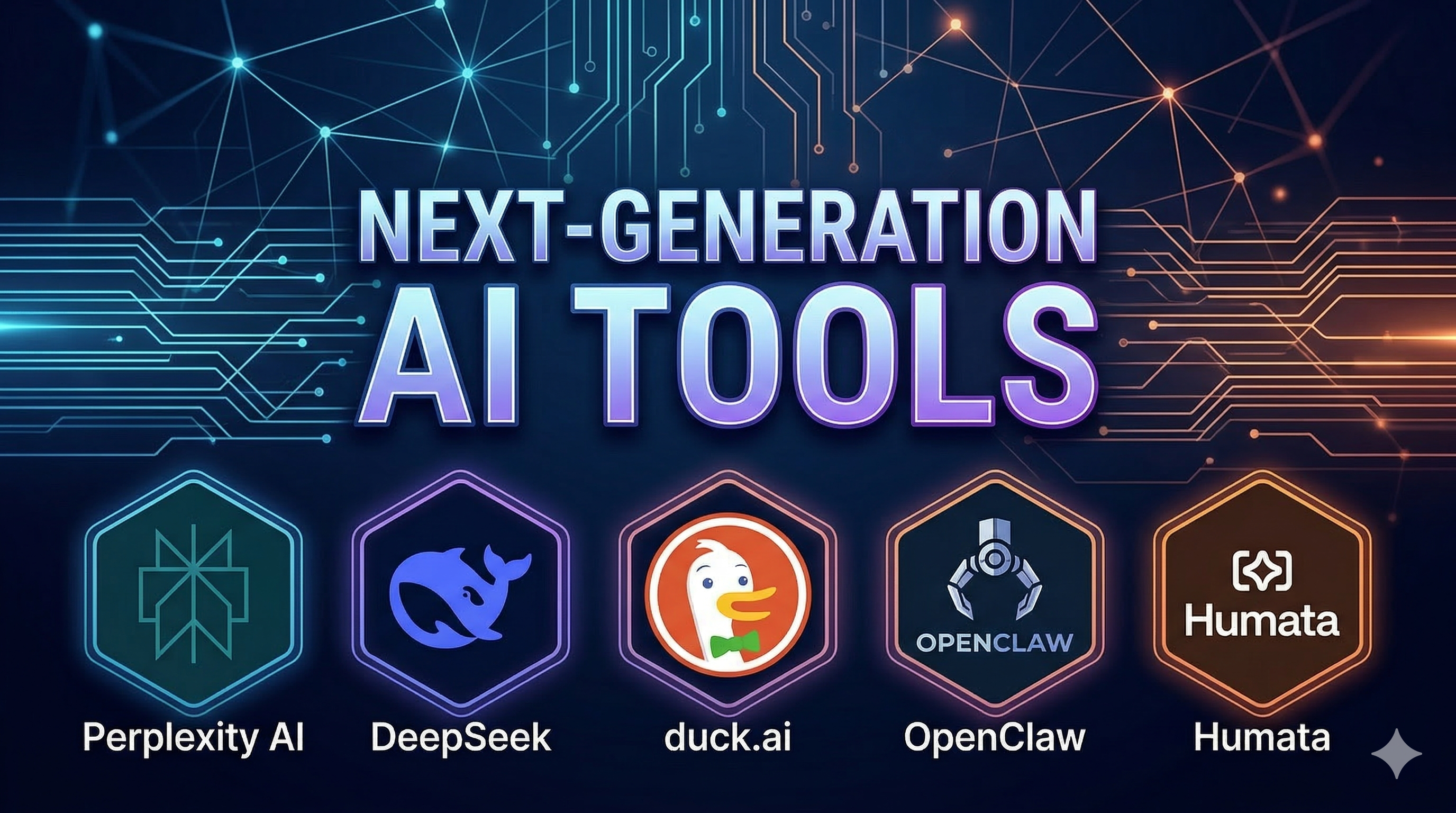
The Age of Everyday Artificial Intelligence
Artificial Intelligence in 2026 has transitioned from a specialized research field into a ubiquitous “cognitive amplifier” for everyday use. No longer limited to tech giants, AI is now embedded in everything from creative suites to development platforms, democratizing access to high-level computing through simple browser prompts. So in a day or so new AI Tools are being released.
For the modern tech enthusiast—be they a developer, researcher, or creator—these tools act as digital collaborators that accelerate thinking and expand human capability rather than replacing it. While the sheer volume of new applications can be overwhelming, the most transformative shift is that many of the most sophisticated models are now free and accessible to anyone with an internet connection.
This article highlights five essential, free AI tools across research, reasoning, and open-source innovation. By mastering these platforms, users can effectively navigate the 2026 digital landscape to boost productivity and foster innovation.
1. Perplexity AI – The Research Assistant of the AI Era

Among the most transformative AI tools available today is Perplexity AI, often described as a hybrid between a search engine and an intelligent research assistant.
Traditional search engines operate through lists of links. When a user asks a question, the engine provides webpages that may contain the answer. The user must then open multiple sources and synthesize the information manually.
Perplexity AI changes this process entirely.
Instead of presenting a list of links, the system reads information from multiple sources and generates a direct answer with citations. It effectively performs the first stage of research automatically.
How It Works
Perplexity integrates large language models with real-time web search. When a user asks a question, the system performs several steps:
- Searches the internet for relevant sources
- Extracts information from trusted webpages
- Synthesizes the information into a clear response
- Provides citations linking back to original sources
The result resembles a conversation with a knowledgeable researcher.
For example, a user might ask:
“Explain quantum computing in simple terms.”
Instead of reading multiple articles, the user receives a concise explanation with references.
Why It Matters
The importance of this tool becomes clear when we consider the growing complexity of information online. The internet now contains billions of pages. Finding accurate and relevant knowledge is increasingly difficult.
Perplexity acts like a research librarian who never sleeps.
Students can use it to explore academic topics. Developers can investigate programming problems. Journalists can verify facts. Tech enthusiasts can stay updated on emerging technologies.
Example Use Cases
- Researching scientific concepts
- Exploring programming frameworks
- Fact-checking news or statistics
- Summarizing complex topics quickly
Limitations
Despite its power, Perplexity still depends on external sources. If those sources contain errors or outdated information, the response may reflect those inaccuracies.
Therefore, critical thinking remains essential.
Nevertheless, for research-heavy tasks, Perplexity has become one of the most valuable free AI tools available today.
2. DeepSeek – The AI That Excels at Reasoning
Another AI tool that has gained significant attention in recent years is DeepSeek, a generative AI chatbot designed with strong reasoning capabilities.
Released in 2025, DeepSeek quickly gained popularity because of its ability to solve logic problems, mathematical questions, and complex programming challenges. In fact, it briefly became the most downloaded free app on the iOS App Store shortly after its release.
Why DeepSeek Is Different
Most AI chatbots excel at generating text, but reasoning tasks—such as mathematics or logical deduction—have historically been difficult for AI systems.
DeepSeek was specifically designed to address this weakness.
The system emphasizes structured thinking, step-by-step reasoning, and problem decomposition. Instead of producing quick guesses, it attempts to break down complex problems logically.
Analogy: A Mathematical Tutor
Imagine asking a teacher how to solve an equation. A good teacher does not simply give the final answer. Instead, they show the reasoning process step by step.
DeepSeek attempts to replicate this educational approach.
For example, when asked a complex mathematics question, the model often provides intermediate reasoning steps before delivering the final solution.
Applications for Tech Enthusiasts
DeepSeek is particularly useful for users interested in technical subjects such as:
- Programming and debugging
- Algorithm design
- Mathematics and data science
- Logical reasoning problems
Furthermore, Developers frequently use it to analyze code snippets or explore alternative implementations of algorithms.
The Open-Source Advantage
Another reason DeepSeek has attracted attention is its openness compared to some proprietary AI systems. Parts of its models and technology are released with open licenses, enabling experimentation and research.
However, this openness encourages innovation and community-driven development.
Limitations
Like all generative AI systems, DeepSeek may occasionally produce incorrect answers or hallucinations. Users should treat its responses as guidance rather than unquestionable truth.
Nevertheless, its strong reasoning capabilities make it one of the most exciting free AI tools currently available.
3. Duck.ai – Privacy-Focused Artificial Intelligence

As artificial intelligence becomes increasingly integrated into daily life, concerns about privacy and data security have grown dramatically.
Many AI services store conversations on servers or use user data to improve their models. For privacy-conscious users, this raises legitimate concerns.
This is where Duck.ai, developed by DuckDuckGo, becomes particularly interesting.
Duck.ai provides a free AI chat system designed with privacy as a core principle.
How Duck.ai Works
Duck.ai allows users to interact with multiple large language models while maintaining anonymity. The system anonymizes requests before sending them to AI providers, ensuring that personal data is not directly tied to conversations.
Additionally:
- Conversations can be stored locally on the user’s device
- Data is not retained for model training
- Users can disable the feature entirely if desired
Moreover, this approach contrasts with many mainstream AI platforms that store prompts and responses on cloud servers.
Why Privacy Matters
Consider a simple example.
If a developer pastes proprietary code into an AI chatbot for debugging, they may unknowingly expose confidential information. Similarly, students or researchers may share sensitive project data.
However ,privacy-focused tools reduce these risks. Duck.ai essentially functions as an AI assistant with a privacy shield.
Features
Duck.ai offers several useful capabilities:
- AI chat with multiple models
- Image generation through prompts
- Voice chat interaction
- Local storage of conversations
For users concerned about digital privacy, this platform represents an important alternative.
As AI adoption continues to grow, privacy will become one of the defining technological debates of the decade.
Tools like Duck.ai demonstrate that powerful AI systems can exist without sacrificing user confidentiality.
4. OpenClaw – The Rise of Autonomous AI Agents
While chatbots have become widely popular, a new frontier of AI is emerging: autonomous agents.
The Bigger Picture
Instead of merely answering questions, these systems can perform tasks on behalf of the user.
One of the most interesting free tools in this category is OpenClaw.
OpenClaw is an open-source autonomous AI assistant capable of executing tasks using large language models.
What Is an AI Agent?
To understand OpenClaw, imagine the difference between asking a question and delegating a task.
A traditional chatbot might answer:
“How do I create a website?”
An AI agent, however, might actually build parts of the website for you.
Agents can:
- Analyze instructions
- Break tasks into steps
- Use external tools
- Execute actions automatically
This concept moves AI from passive conversation to active assistance.
Real-World Analogy
Think of a personal assistant.
If you ask a human assistant to organize a meeting, they do not simply explain how to do it—they actually schedule the meeting, send emails, and arrange logistics.
AI agents aim to replicate this behavior digitally.
What OpenClaw Can Do
OpenClaw can integrate with messaging platforms and perform automated tasks through AI models.
Examples include:
- Automating repetitive digital tasks
- Managing workflows
- Gathering information online
- Executing commands through integrated tools
Because it is open source, developers can modify the system to create custom AI assistants.
Why Tech Enthusiasts Should Explore It
OpenClaw represents the next evolutionary step in AI applications.
Instead of interacting with isolated AI tools, users can create systems that perform entire workflows automatically.
For programmers and automation enthusiasts, this opens exciting possibilities.
5. Humata AI

In an era defined by information overload, Humata AI has emerged as a specialized “GPS for documents,” transforming the way researchers, legal professionals, and students interact with dense text. Often described as “ChatGPT for your files,” Humata is a document-centric AI assistant designed to extract, summarize, and synthesize information from uploaded PDFs and other document formats with surgical precision.
Core Capabilities and Features
Unlike general-purpose chatbots that rely on broad internet training data, Humata operates within a “Closed-Loop” Knowledge System. When a user uploads a file, the AI creates a semantic map of that specific document, ensuring that every answer is anchored directly to the provided text.
- Interactive Q&A with Instant Citations: The platform’s standout feature is its transparency. When it answers a query—such as “What are the termination clauses in this contract?”—it doesn’t just provide text; it provides clickable citations that jump the user directly to the relevant page and paragraph, effectively eliminating the “black box” problem of AI hallucinations.
- Multi-Document Synthesis: Advanced versions of the tool allow users to query entire folders at once. This enables cross-document analysis, such as comparing methodologies across multiple scientific papers or identifying conflicting terms across various legal briefs.
- Semantic Search & OCR: Beyond simple keyword matching, Humata uses Vector Embeddings to understand the conceptual meaning of a query. Its integrated Optical Character Recognition (OCR) technology ensures that even scanned, non-searchable PDFs are readable and actionable.
- Privacy-First Architecture: Recognizing the sensitivity of research and legal data, Humata employs enterprise-grade encryption. It is built on the principle that user data is private and is not used to train global models, making it a viable choice for industries with strict confidentiality requirements.
AI Research Ecosystems and the Future of Knowledge
While individual tools are powerful, the real revolution lies in how AI systems are increasingly connected into broader ecosystems.
Modern AI platforms combine language models, search engines, databases, and automation tools into integrated environments.
This approach reflects a larger shift in the philosophy of technology.
From Tools to Collaborators
Traditional software operates through commands.
You instruct the program exactly what to do.
AI systems, however, operate through intent.
You describe a goal, and the system determines how to achieve it.
For example:
- Instead of manually researching a topic, AI synthesizes information.
- So, Instead of designing graphics manually, AI generates visual concepts.
- Instead Andof writing code line by line, AI assists with development.
This transformation turns software into a collaborative partner.
The Role of AI Literacy
As AI becomes more integrated into everyday workflows, a new skill is emerging: AI literacy.
This skill involves understanding:
- How to write effective prompts
- And How to evaluate AI-generated information
- How to combine multiple tools effectively
Tech enthusiasts who master these skills will gain a significant advantage in both professional and creative domains.
Example: A Modern AI Workflow
Consider how a tech blogger might use AI tools together:
- Research topic using Perplexity AI
- Analyze technical concepts using DeepSeek
- Verify facts through external sources
- Generate visuals or diagrams with creative AI tools
- Automate publishing workflows using AI agents
This integrated approach dramatically increases productivity.
Conclusion: The Democratization of Intelligence
Artificial intelligence is entering a new phase of technological evolution.
Just as electricity transformed industry and the internet transformed communication, AI is transforming human cognition itself.
Free AI tools have made this transformation accessible to everyone. What once required advanced research labs can now be explored from a laptop or smartphone.
The five tools discussed in this article illustrate different dimensions of this revolution:
- Perplexity AI – redefining research and information discovery
- DeepSeek – advancing reasoning and technical problem solving
- Duck.ai – prioritizing privacy in AI interactions
- OpenClaw – pioneering autonomous AI agents
- AI ecosystems – shaping the future of collaborative intelligence
Together, they demonstrate the incredible diversity of modern AI technology.
For tech enthusiasts, the message is clear: this is the best time in history to explore artificial intelligence.
Experimenting with these tools does not merely improve productivity. It expands creativity, curiosity, and the ability to solve complex problems.
In the coming years, the people who understand AI will not necessarily be those who build the models—but those who learn how to collaborate with them effectively.
The future of technology is not simply artificial intelligence.
It is human intelligence amplified by AI.